Text & Interview: Roberto Beseler Maxwell
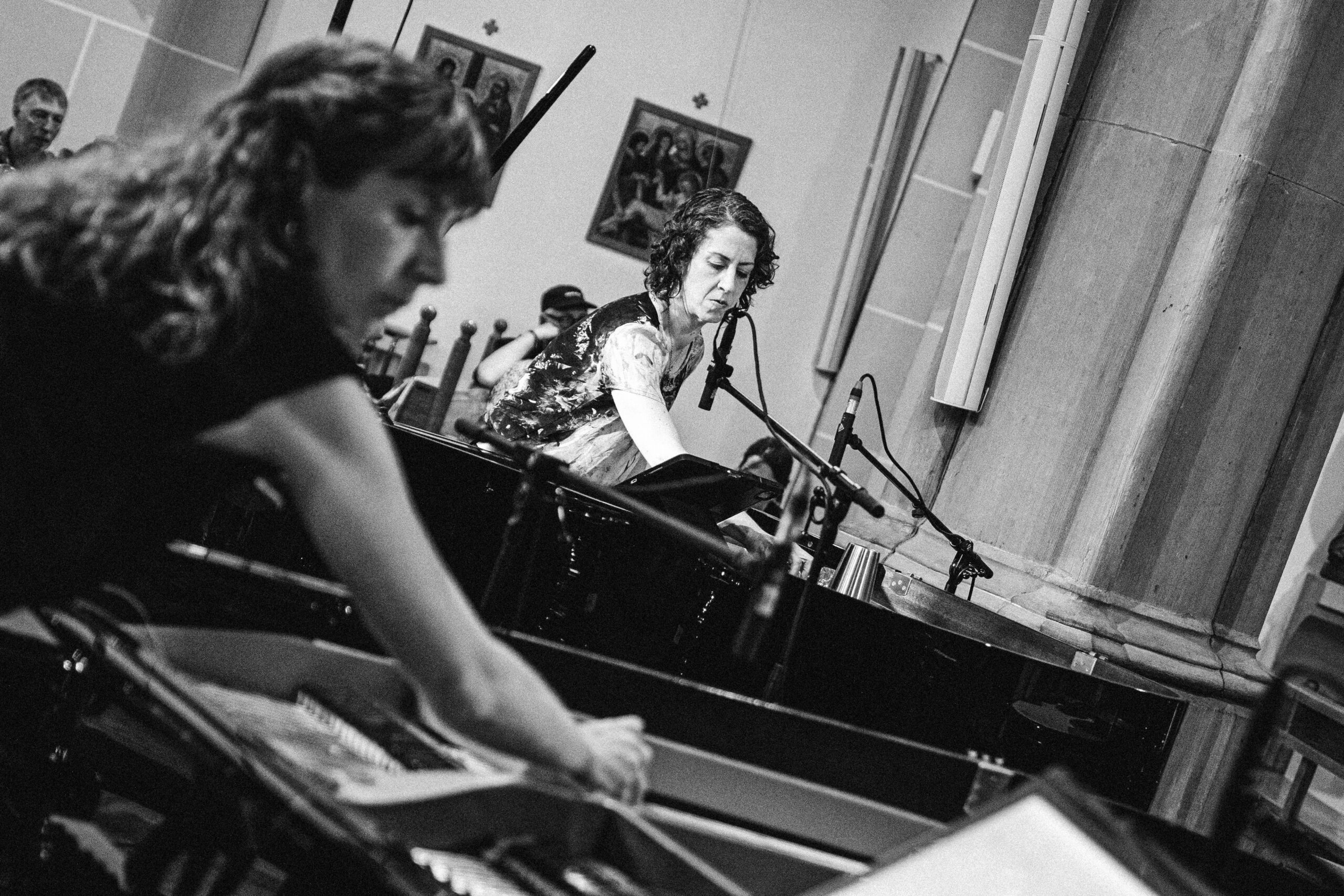
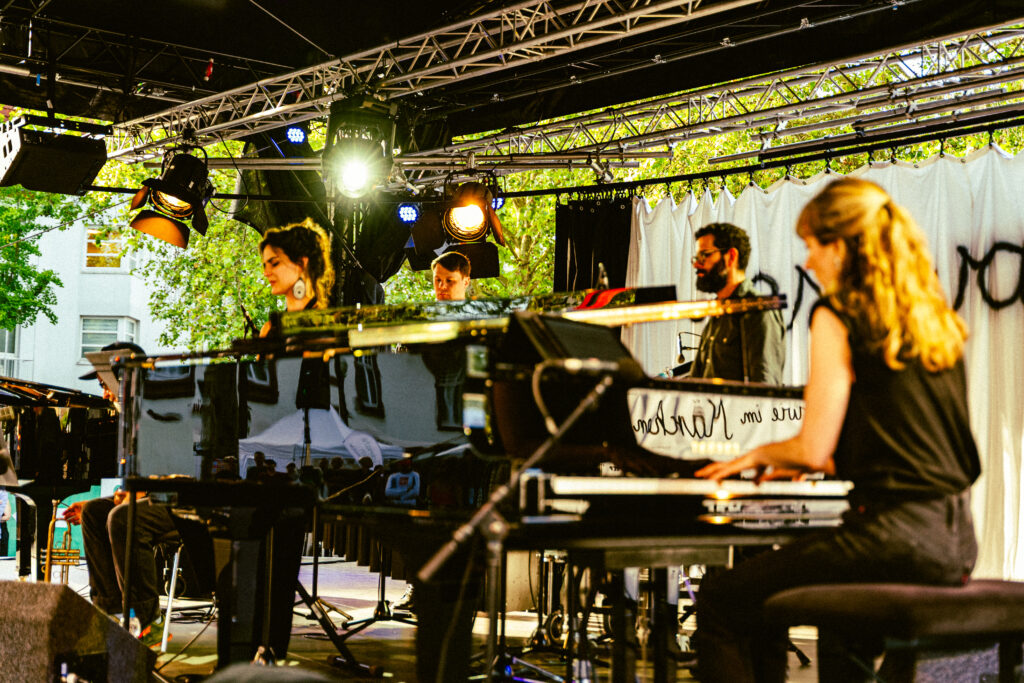
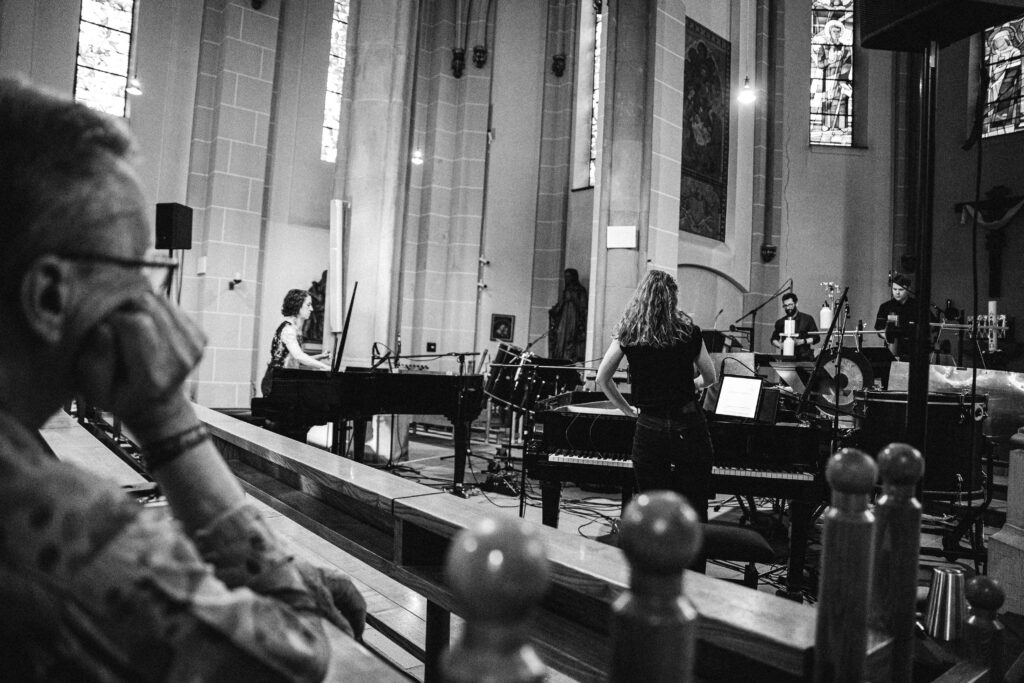
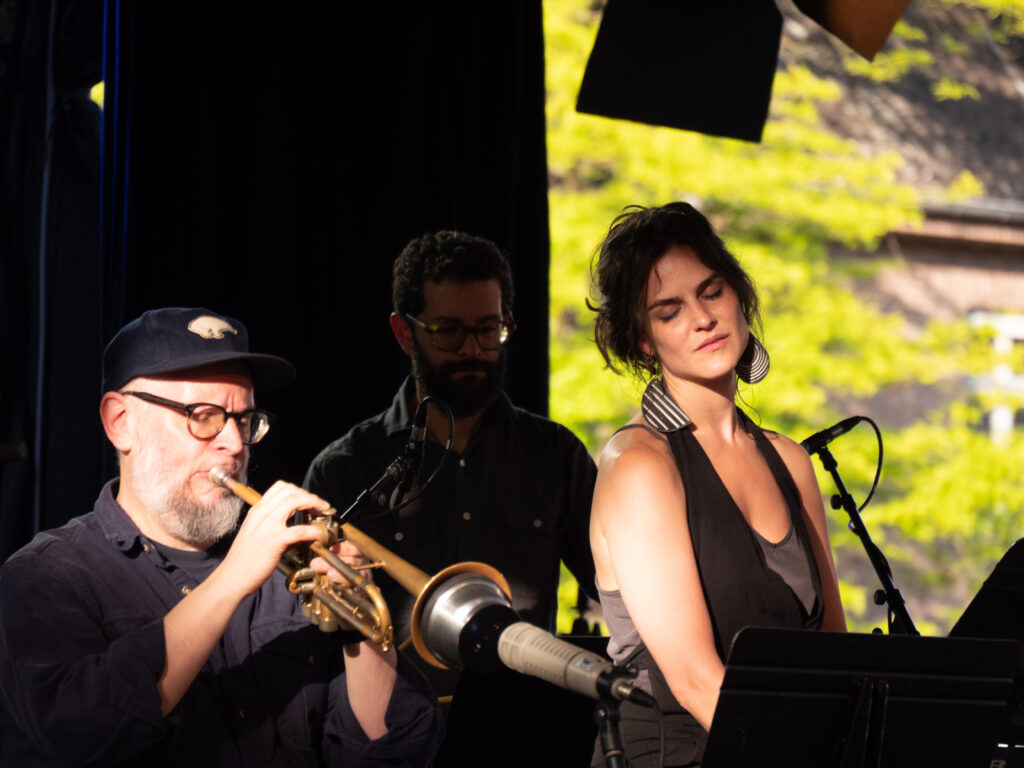
Russell ist zusammen mit Laura Barger Gründungsmitglied des New Yorker Quartets Yarn/Wire, die auf dem diesjährigen Moers Festival zwei Konzerte gaben. Am Freitag den 22. Mai führten sie auf dem Kastellplatz, die Haupt- und zugleich Open-Air Bühne, das Stück »After Nan Shephard« von Nate Wooley auf. Am darauffolgenden gab es die Stücke »i tell you i want to be one sticking out of the ground like a tongue« von Jonah Haven und »Supraseether« von Bergrún Snæbjörnsdóttir in der St. Josef Kirche zu hören. Das passierte als Teil der Reihe currents, bei der sie mit jüngeren oder noch nicht ganz etablierten Komponist:innen zusammenarbeiten, wie auch mit Musiker:innen, die sich nicht zwangsläufig als Komponist:innen bezeichnen.
Wer beim zweiten Konzert die Augen geschlossen hielt, wäre vielleicht nicht direkt darauf gekommen, dass es sich bei der Besetzung um zwei Klaviere und zwei Perkussionist:innen handelt. Gerade diese klangliche Radierung beider Instrumentengruppen macht Yarn/Wire als Klangkörper aus. Die klassische Herangehensweise an die Instrumente verschwimmt an der Grenze zwischen Perkussion und dem Klavier. Die Rollen werden getauscht oder vertauscht. Dabei passt das »Neue Musik-Ensemble« Yarn/Wire besonders gut zum Moers Festival. Warum genau, im Interview.
Roberto Beseler Maxwell
Did you know about the festival before coming over?
Russell Greenberg
I didn’t, this was our first time here. But when we were talking to Nate about it, he said: »Oh, it’s a great festival«. So we got a little background on the festival, but we didn’t know what to expect at all.
RBM
You’ve been here for a few days now. How’s your general experience been outside of the standard rehearsing and performing?
RG
I have to say it’s one of the nicest festivals we’ve been to so far, especially regarding how it’s integrated into the community. It’s not just a music festival. There is really a kind of open atmosphere. It’s very welcoming and I know there are a lot of music fans here who really know what’s going on. But it also feels like the doors are open to all listeners.
RBM
Maybe a naive question: Is this the type of festival you normally play at, or is this an exception?
RG
I think this is more of the exception than anything. I was saying to someone that a festival back in the US that feels most familiar to me would be something like Big Ears in Tennessee. But it’s very different from that. It is similarly wide in the musical sense and there’s probably some overlap with the artists. But in terms of how it integrates with the city—the food, the vendors—it’s different. I even brought my kids here.
RBM
It’s a very kid-friendly festival.
RG
Yes, indeed. I would never think to bring them anywhere. But when I talked to the booking and production manager Julianne Höttges I told them: »I’m thinking about bringing my kids«, and she was: »Go for it«. So it makes music that’s experimental, challenging and difficult more normal. Which is very refreshing. I feel less stressed. I’m curious whether other festival-goers feel that same vibe.
RBM
I feel similarly. Listening to your concert yesterday, it felt so refreshing because if you go to a new music festival where every concert takes on the same angle, at some point the input becomes hard to digest. So even for me, someone that goes to many of these concerts, after the fifth concert I feel like I need a break. Here, I find it much easier to listen deeply and concentrate when hearing a concert like yours and then later go outside and listen to something completely different. This clash is very productive for me.
RG
Totally, it’s productive for me, too. There’s quote-unquote an »ideal place for concert music«, if that’s what we do. That’s another discussion. I think juxtaposing it against different genres and unexpected venues makes you reframe it and see how it works in different places. It makes you play differently. When we were in the church hearing the resonance, we were thinking »Okay, this is how these pieces work in here.« And then the piece we did with Nate Wooley on an outdoor stage with sound coming from the environment, it really reframed the whole thing as well. I think it’s really artistically valuable.
RBM
Is this a context you’d like to play in?
RG
Absolutely. I think it’s pretty refreshing. It’s not the only one that I would want to play in, but I’m really grateful that it exists and that it changes one’s viewpoint.
RBM
Could you give a small insight into how the concerts came to happen in Moers?
RG
Totally. So Julianne Höttges got in touch and mentioned that she’d like to bring Yarn/Wire. I told her some of the projects that we were involved in, f.e. the piece by Nate Wooley that he was writing for us in collaboration with Issue Project Room in Brooklyn. I think it was a natural choice because Nate does so many different types of music, and he’s been to Moers before. Having our side of things interface with his was a really good springboard.
For the currents concert it just so happened that we’re playing these two pieces in New York next week. Because of scheduling, it made sense to collaborate on those commissions. We don’t usually do co-commissions with a festival, but it turned out really nicely because we got to work with Begrun and Jonah, who, by the way, lives in Bremen. There were so many lucky coincidences with the whole thing that it just made sense to make it happen.
RBM
I checked: you’ve been working with the idea of the currents series since 2013.
RG
Yes, it’s long time. The way it works in the US is we’re pretty much a self-run organization and it’s our way of commissioning composers. We don’t typically get outside help from it, so we choose emerging composers and really interesting people that are outside of »classical« composition. We’ve worked with Mark Fell, for example, and it’s our way of keeping our ears open and being exploratory. So it’s been something we’ve been really dedicated to for a really long time. It’s largely organizationally driven.
RBM
As you just mentioned, you like to play with the idea of who a composer is and how composers work. When I see you perform—and this is just my impression—I feel that you also challenge the traditional role of the instrumentalist as someone who plays only one instrument. Obviously, people compose for you, but I’ve noticed a very interdisciplinary approach to both instrumentation and the performative aspect of the concert.
RG
I think looking back at what’s happened, that is definitely something we’re thinking about. I was having a conversation with someone today about why we do this. You have to love music and no one’s telling us what to play. We’re building this performance practice around exploration. We have to present it well. We have to get into these composers‘ minds and just live it as much as possible. So the music stand is always there, but that’s just the starting point. We’ve really built this way of getting beyond that.
I will say, and our pianist and founding member Laura Barger would say this, too: She and fellow pianist Julia Den Boer have had to not become percussionists, exactly, but go beyond their instruments probably more than Dustin Donahue and I have. Because as a percussionist, if someone tells me to play a music box, I’m all for the challenge. It’s within the realm of what we do. But Laura and Julia have had to really step beyond, and they’re game.
RBM
You do notice that. In a sense it’s also expanding the idea of a piano, which of course has percussive elements.
RG
Totally. We’re also in a funny time: I don’t know if you’ve noticed this, too, but pianos are hard to write for. A lot of composers are dealing with tunings or want to bend and get at different musical possibilities. The piano is actually an old technology. But it’s also present in our musical memories so it’s really challenging. This is something we confront all the time.
RBM
Have you ever thought about using, for example, harpsichords or spinets— instruments that are easier to tune?
RG
You’re right. Typically what happens is we’ll approach a composer, and we don’t give them many rules. Maybe that’s a problem. But eventually they’re like, »This is what I came up with.« And it’s really interesting what people choose. So if someone did that, why not? In fact, we just did a concerto with George Lewis where he wrote for two pianos. One pianist has a harpsichord, one pianist plays a celesta, and both play harmoniums. But they’re normally tuned…
RBM
Going back to the Moers Festival: One thing I was noticing at the concert yesterday is that a lot of people in the first rows were trying to understand how you were creating sounds, with the utmost curiosity. My impression is that much of the audience doesn’t come from a classical new-music background, where form or instrumentation might be the primary focus. People seemed very curious and engaged with the visual aspect of the performance. Did you feel that as well?
RG
I did. I think more during the second piece because I was closer to the audience. I saw someone come right up next to me to watch, which was great. Then, at one moment, I looked up and saw this guy in the front row kind of nodding his head and I thought »Okay, cool«. So there’s a different entry point than at a typical new music concert.
RBM
You touched on this before: I guess there are big differences between Europe, or let’s say Germany, and the US in terms of new music? How does that affect your work?
RG
It’s interesting. It’s hard for me to paint a broad brush. We are really fortunate to play in both places. We’ve been doing this now for 20 years. Laura and I have been doing it since the beginning, as we’ve had a couple membership changes. Not many US new music ensembles come over that often. So I guess what I’ve seen really only applies to my experience and to our ensemble. That’s why I don’t wanna be super general.
In Germany, I would say that at new music festivals, you’ll find people who aren’t necessarily new music fans but willing to check it out. In my experience, there’s less of a schism between the public and the people who really know what’s going on.
RBM
So it’s more fluid.
RG
Much more fluid. When you view something from the outside, you always view it a little rosier, a little different, so I’m acknowledging that’s definitely there. But another positive thing I notice is that the funding structures are very different, and they benefit a broader range of people.
In the US, funding tends to come more from private sources, foundations, or self-funding by ensembles and festivals. So I think just the structure of each place is leading to different work. When we came here I commented to someone »The technicians are amazing here.« They’re so good and everyone just sounds so amazing. Technicians in the US are also amazing, but a lot of the work has to be done by the ensembles.
RBM
Because of this funding difference?
RG
I think so, and a professionalism thing. That’s not to say anything about the quality of the people or the work. It’s just that you can feel the effects of how things are organized. And I think there’s way fewer music festivals like this that cater to lots of different music in the US.
RBM
It’s more compartmentalized into genres.
RG
Yeah, totally. And there’s plenty of exceptions to everything that I’m saying, but if I’m to give a generalization, those would be some of the things. You really feel it structurally and socially.
RBM
Do you have any takeaways? Maybe things you’ve learned or you’ve realized from this small trip here?
RG
Maybe going back to your first question. I think there’s a lot of value in pushing music into different spaces and finding the unexpected. There’s always gonna be an ideal place for any given kind of music. A DJ set of one type of genre might be perfect in a certain room, right? But let’s put it in a forest and see what happens. Or this new music piece could be in this chamber music hall, but let’s put it outdoors in the middle of a festival. I think there’s a lot to be said about pushing the stuff into different spaces. That would be my takeaway. Until we played the concerts, we wouldn’t know what to expect. And let’s say we did these same concerts again next year at the festival, they’d probably be in a different space, and we’d have a totally different experience.
RBM
Interesting. That also speaks very positively about you in the sense that you let yourself go with the flow. I know of a few cases where people would be very nervous about this kind of situation, not having everything under control. I suppose that’s usually the reaction.
RG
You have to trust a lot. I feel that everything I got from the organizers, from the way everything is laid out, is very much about trust. No one’s trying to make anything bad; they’re trying to see where things might flourish. So I think having that trust with the organization, with the ensembles, with the music that people are bringing goes a long way.
It’s been a very positive experience altogether. Speaking for someone who’s not here, Julia did this thing called the Piano Mobile [Anm. d. Red.: das Piano Mobile ist ein Hybrid aus Mini-LKW und Transporter, auf dessen Ladefläche ein Standklavier steht und musikalische Darbietungen über das gesamte Festivalgelände bringt] and said it was one of the top six, I don’t know why she said six, but one of the top musical experiences that she’s had.
RBM
Not bad!
RG
Just because it was so unique and special to play for people in the community. She played some Linda Catlin Smith, maybe some Feldman. This strange context really inspired her. What was also unexpected and exciting for us were the sessions. New music groups never get to do that stuff. I think in the future it’d be like, »We should do more of that«, because that’s where it really comes alive.
RBM
I also feel Moers plays a lot with humor. It’s really a funny festival. The Piano Mobile can be taken seriously, but it’s also very funny. And then there’s blasting a mashed-up speech of Trump, which can be annoying—I think it’s supposed to be annoying. At the same time, I can take it with humor.
RG
I’m glad you can. I think for us it was pretty traumatic.
RBM
I imagine! It’s probably very different depending on your standpoint or perspective. But the humorous side is also good for this sense of scaling down the idea of new music as some kind of holy grail, and making it more enjoyable for a broader audience.
RG
It’s super interesting to be a part of that, for sure. And also we do tend to work with more improvisers and so it’s not that weird. But usually we are set in a specific context and not allowed to do, in a festival, all those different things.
RBM
You’re maybe coming as a »labeled« ensemble. But then you get to do all these other things.
RG
Totally.
RBM
And why not? In the end you’re all musicians.
RG
Absolutely. It’s almost like what we do with the currents series fits best here. Because that’s what the festival is about: exploration.