Text: Peter Margasak
German translation
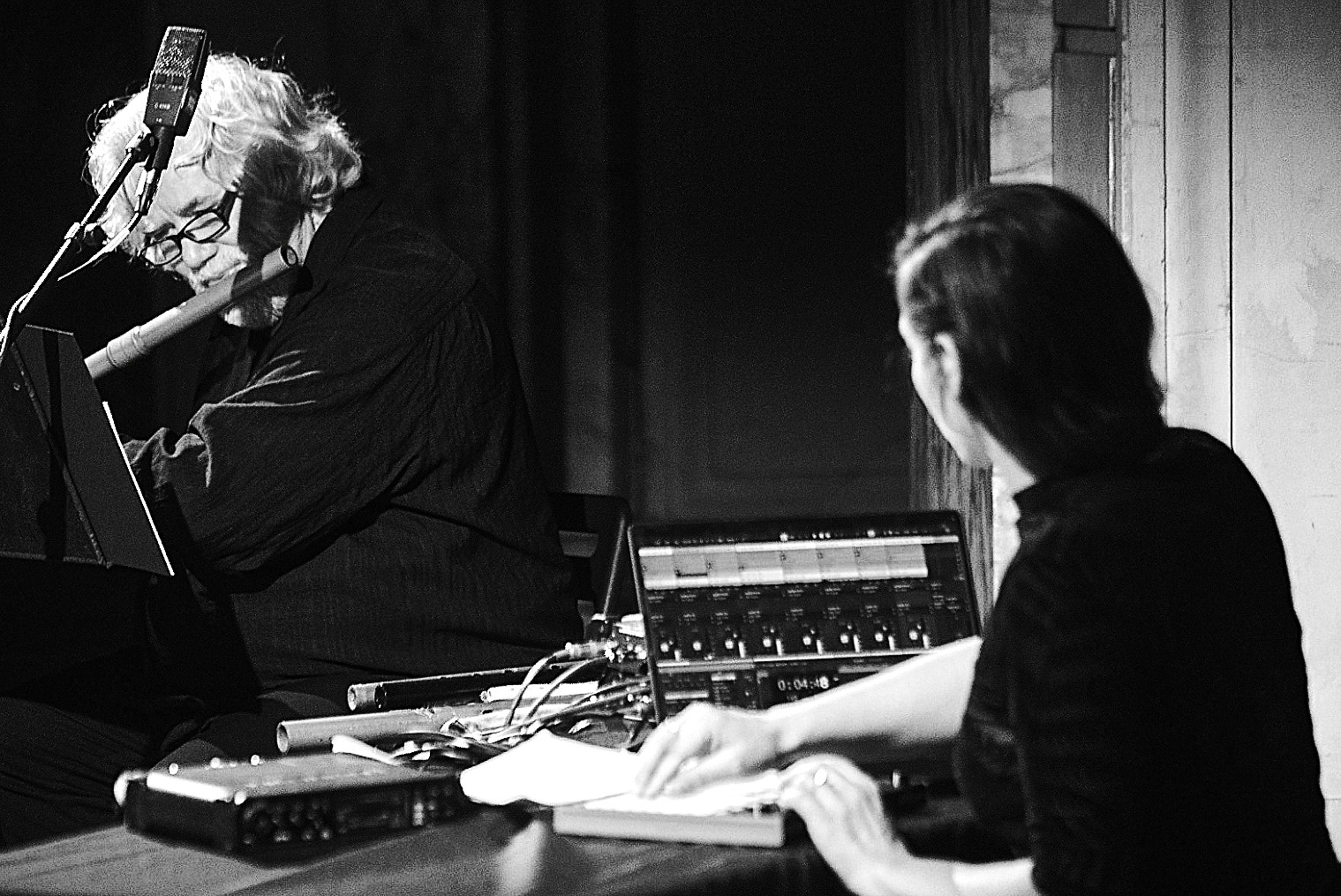
As one of the preeminent figures in medieval music the average listener might not expect flutist Norbert Rodenkirchen to be a crucial part of one of the most unusual experimental works of 2026. The Cologne native is the source of every sound on »The Days Pass Quickly Immersed in the Shadow of Eternity«, a fascinating composition by the American composer and musician Lea Bertucci commissioned by ZKM Karlsruhe. The artists spent several years working together, with Rodenkirchen tapping his impressive collection of historical instruments to produce a library of some 60 samples which Bertucci meticulously assembled into a multi-channel sound work over which the flutist plays in real-time. Each performance of the piece is unique, with the varied sound systems, acoustic properties unique to each performance space, and Bertucci’s live mixing presenting the soloist with an ever-changing sonic landscape which he must adapt to as he plays. Since the flutes played by Rodenkirchen for the project span centuries, Bertucci had to grapple with the fact that many of the instruments use different tunings, and stacked upon one another they create a hallucinogenic fabric of microtonal harmony. The work elegantly reconciles the ancient and the contemporary, with technology allowing Bertucci to construct an speculative journey where the elemental quality of the massed flutes creates something both timeless and out-of-time.
Rodenkirchen’s devotion to medieval music has been cemented by his lengthy membership in the legendary early music ensemble Sequentia—he’s been a member since 1996—to say nothing of his close association with the acclaimed French ensemble Dialogos. His tireless research into music created before notation and tuning systems had become standardized have made him one of the most important and innovative figures in the entire field of early music, yet despite his ongoing commitment to ancient sounds he’s never been interested in maintaining stylistic or historical boundaries. In fact, Rodenkirchen’s involvement in experimental music is hardly new. When he first began studying music his focus was geared toward contemporary work, but more than any style or era, he remains drawn to sound, first and foremost. Early music provided a thrilling pathway toward the extended techniques he was encountering in new music. »I was always fascinated by the sonorities of these ancient flutes, and my main intention to discover and to go more into medieval music was the sound, or I must say the unknown sound, because nobody really knows how medieval music sounded,« explains Rodenkirchen during a recent interview. »Whenever I saw medieval instruments and I heard them, I was fascinated by the way musicians approached these instruments, and I heard something.«
As he immersed himself in early music he began noticing how certain techniques and musical qualities endured over the centuries and rather than drawing lines he has always focused on continuities. For instance, while many listeners have heard the technique of singing into a flute while playing it through the work of jazz reedist Rahsaan Roland Kirk or Jethro Tull’s Ian Anderson, Rodenkirchen discovered that the practice stretched back far into the past. »Sound distortion, masking sounds, and changing the envelope was always a technique in ancient times to create something magical,« he says. »Sometimes it had ritual meanings, to change the sound of a voice or an instrument with what we would today call a prepared instrument. That all fascinated me very much, and it was my initial approach. Through the practical work with medieval groups, I went much more deeply into all the questions of the repertoire, the composition, and also how much improvisation is involved when we reconstruct missing parts of that tradition.«
Over the years Rodenkirchen’s immersion in early music has created an identity that he doesn’t wholly embrace. Raising a family forced him to prioritize financial stability, which he achieved through his membership in Sequentia and a fruitful involvement in theater and film productions. »I cannot put my musical fantasy into just one style and I cannot really say that medieval music is the absolute focus of my life,« he explains. »It is not. I find a lot of truth for myself in it, and I like to play it, and it seems to be the thing which I do most convincingly. I have to deal with these two aspects of whether it’s basically the same water in which I’m diving when I’m improvising in early music or in avant-garde music? Is it not the same water? That’s how I sometimes describe it, is it salt water or lake water? I would say it’s partly the same. It’s partly not the same.«
His initial interest in experimental music never vanished even through for many years it was something he pursued, but that abiding interest in sound eventually led him back to more contemporary approaches, beginning with his 2006 recording Hidden Fresco with violinist Albrecht Mauer, a fellow Cologne native who also straddles early music with an experimental practice. The flutist, who also plays harp on the album, refers to it as »something like medieval free jazz or a medieval record with just fiddle and transverse flute, but not one not of medieval music.« He extended that approach with his collaborative 2018 album Opalescence with double bassist James Ilgenfritz and mutli-instrumentalist and fellow invented instrument advocate Robbie Lee—both prominent figures in New York’s experimental music community—who share the flutist’s interest in microtonality, early music, and improvisation. These days he seeks to find a balance between his medieval work and his more experimental playing.
When it comes to spontaneous music-making Rodenkirchen prefers the term extempore. »It’s about memorization, and through memorization, getting the freedom to do it the one way or the other,« he says, referring to oral tradition. »If you have a story which you want to tell a certain audience, they expect you to have some variants and some maybe nice ornaments. That’s more or less how we deal with the repertoires in medieval times. That we extemporize it and then have certain freedoms, but not necessarily improvisation in the experimental mode today, where we also try to find something new.« Through his research he has embraced the idea of sonic equivalent of Jungian archetypes. »Because the avant-garde always wants to search for something unheard, something unknown, it’s like a discovery of a new terrain. These are these two different things: one is to be coherent in a certain repertoire and style, but with the openness of some of these findings I had in the avant-garde, and the other approach with James and Robbie, where we try to forget all these repertoire-bound rules. I’m sometimes trying to find archetypes in sound, and this is not in medieval work. In the medieval work I try to play what should be played to accompany Benjamin Bagby, for example, and this probably has a lot of archetypes just by what we do with the ancient texts.«
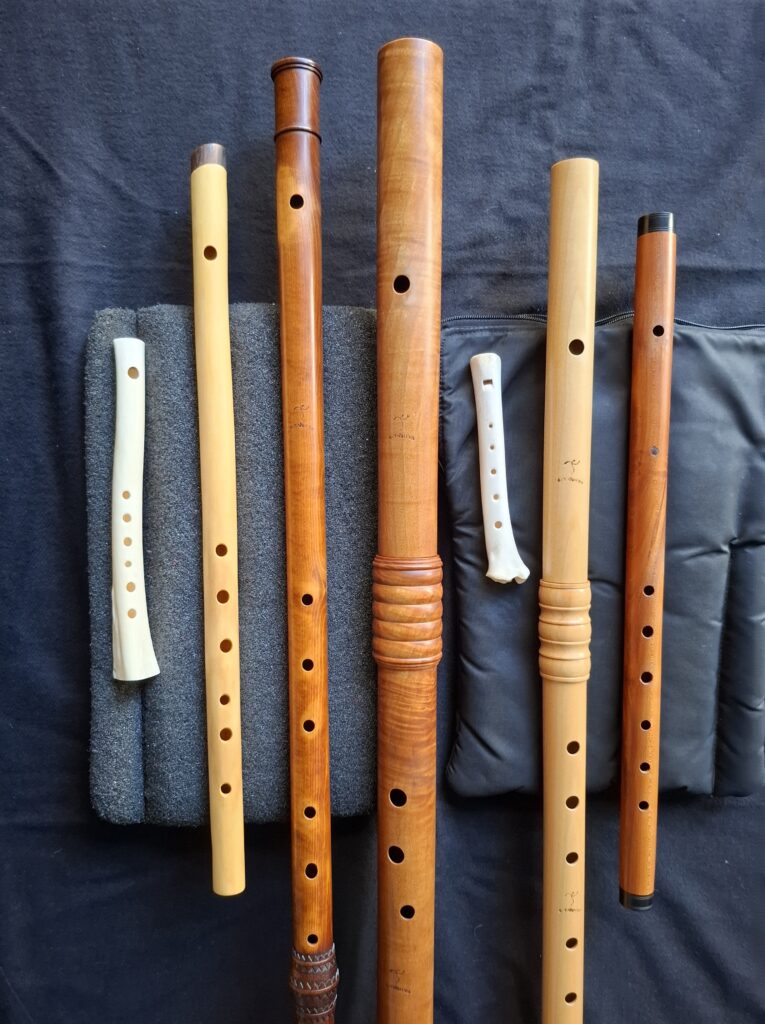
The continuity Rodenkirchen sees in archetypal sounds is something he also assigns to the tools of his trade. Since the early 1990s he’s been an ardent collector of various flutes, gathering them not as a museum curator, but an artist drawn to peculiar qualities each flute possesses. One of the flutes used in the Bertucci project is a replica of a Viking flute found in Northern Germany and later copied by Friedrich von Huene in Boston. »It’s not a paleolithic flute, but it looks exactly the same as the Geisenklöstler flute, which is 35,000 years old. It also has four holes, and it was made from a swan bone. Is it a medieval flute or is it a Paleolithic flute?«
The project with Bertucci has excited the flutist in new ways. »She made careful documentation when we sampled these flutes, noting in which temperament they were,« he recalls of the process. »I gave my personal reflections to her, what should be regarded as important to certain sonorities when you hear them in a bundle, or let’s say in a swarm.« Performing the work demands his close attention from him even though he provided all of the sounds that Bertucci sampled as she composed the piece. »It creates some sonic sensations, which are entirely new to me. I know my flutes, but I don’t know them multiplied and in combinations with some other flutes of mine, which were taken out of other contexts, and when I said before that it touches the question of microtonality, then there’s an interesting thing to say from the point of early music. This is also the great thing in an artwork, that you can always discover new layers of meaning in it. I hear a lot of meaning in Leah’s piece because I can relate to the sounds, which are always a little bit different. The way she mixes it, the way she plays together with me means that there is still a lot of room for our own decisions, how we play together.«
Rodenkirchen refers to some of the sounds in Bertucci’s piece as »emotional microtonality,« a kind of organic, inherent glissando we experience in everyday life. »There are some inflections which really make a difference, but they’re microtonal. For example, the way a mother is humming her baby to sleep—there is so much microtonality involved. Then there’s something else, which is like arbitrary microtones. If you are doing experiments, you must be open to anything which comes out. There should be an openness for the result not to be exactly what you expect.«