Interview: Verena Hahn
Verena Hahn
You’re all interested in building and inventing. Where did you learn what you’re doing? What was teaching you?
Erin Lee Hong
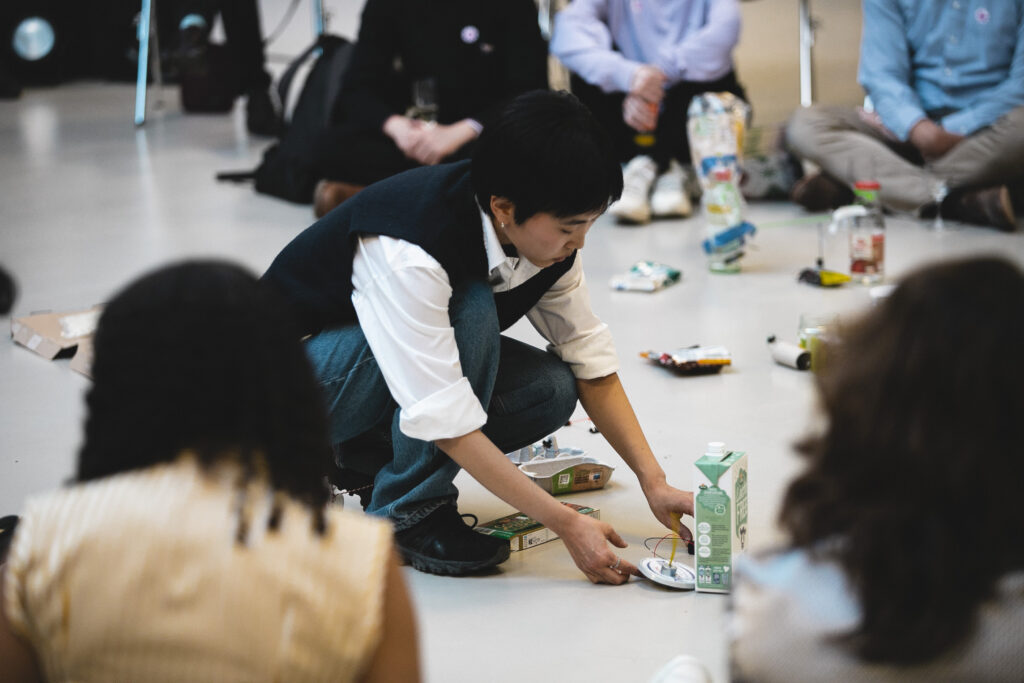
I like to browse through other works or books or the internet to learn for example how a certain circuit or Raspberry Pi code works. And the other half is experimenting on my own. Like, how do I control them and how do they sound? Or how do they react differently from my expectations considering air frequency or space resonance? The ideas behind it are related to my cultural base as well, ideas of displacement or resonance.
Hye Young Sin
For me, it’s not that different. Whenever I go to concerts or exhibitions and find something interesting, I directly ask the artists. And they usually seem very happy to share. I’m also very glad to explain what I’m using or how I built it. I like sharing this kind of information and learning from each other.
Ioana Vreme Moser
I think it really comes from the culture that I grew up in. I’m Romanian and I grew up in a rural setting with a lot of improvised machines around me. Machines were very much tangled up with humans. This was something that inspired me to learn very early how to build my own devices. But I also taught myself how to build and engineer these instruments.
VH
Do you have an example for one of these self-built machines that were around in your childhood?
IVM
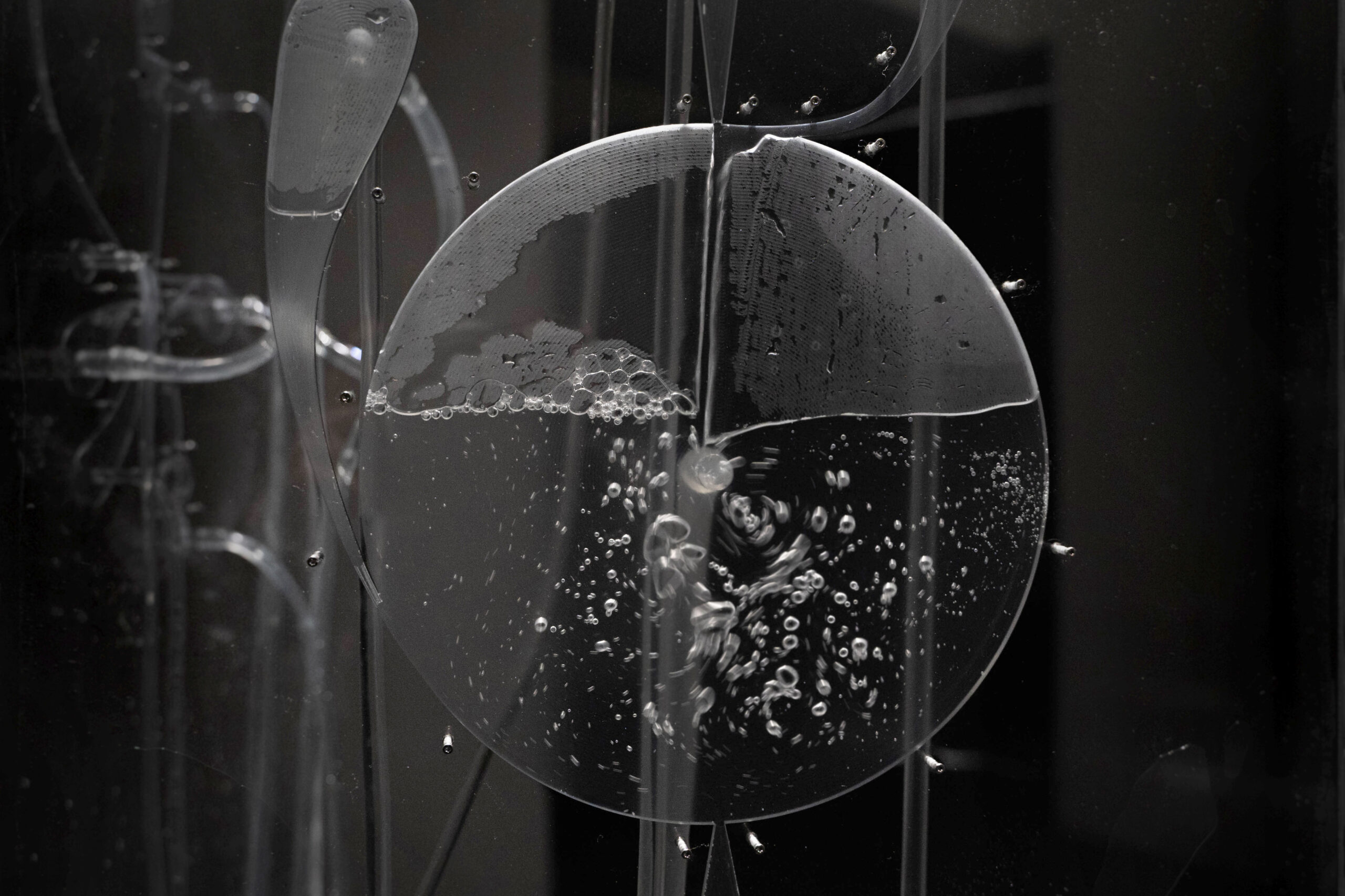
For instance there is this kind of washing machine. It’s a circular wooden barrel that is put into a river. The power of the river is directed to create a vortex and swirl your clothes. I found this element later in other technologies. I also work with these elements, like creating swirls with fluid mechanics. It was inspiring to see all these mechanisms that direct natural forces to create motion and sounds.
VH
All of you invite the audience to get into some kind of emotional relationship with the technology you are using. Erin, you for example built a little creature that looks like a fuzzy animal made of a microphone wind shield. You then asked the audience to give it a name which was recorded by a Raspberry Pi inside of it. Do you think that machines have personalities?
ELH
I think machines might have personalities just because we anthropomorphize them. It’s like with birds: If I see birds I think of them as free, and that reminds me of my human concepts, which are kind of reflected back at me. So from that perspective, it’s interesting to think that machines have some kind of personality.
IVM
The way I see this is through the idea of object memory. I see objects as vessels for human interactions. They embody the history of how they were interacted with. Computers, in turn, are part of a lineage of technologies created from the desire to understand ourselves and the universe around us. For example the astro labes, this Chinese invention to map the sky, or Persian water clocks – these are kind of the first computers. And then they developed into these complex machines that are kind of unrecognizable because they’ve lost their original purpose as tools. I’m trying to figure out how to position these pieces of hardware.
VH
What about you, Hye? In your installations you work with little motors that resemble plants or insect-like creatures. Do they have personalities?
HYS
I don’t think they have personalities, but maybe characteristics. I feel the word personality is already human-centered. However, during the working process, I really feel that materials have something like agency and are not just passive things. The objects show their own behaviour that I cannot fully control. I try to reveal this aspect in my work by creating situations in which objects can generate their own sound or movement.
VH
Many people draw a distinction between the natural and the synthetic and assign them different values. For example natural cosmetics are perceived as healthier or of better quality, and also with music some still have the perception that music coming from an acoustic instrument is of higher value than a synthetic sound source. How do the natural and the synthetic relate to each other in your work?
IVM
I don’t see these borders so clearly because electronics are also made from minerals and ceramics and materials that are natural, but miniaturized, processed and lab grown. A lot of my works deal with where these materials come from. What does it mean to mine for a semiconductor? Or to grow a crystal that becomes a transistor? So for me, this question of materiality is quite important, especially in terms of toxicity. The material I choose is part of the story.
ELH
In my work I do distinguish between the natural and synthetic, but I try to aim for somewhere in the middle. For example, I collect organic materials and then make them somehow sound synthetic or the other way around. By using a transducer I’m integrating physical materials like metal, glass or plastic into the work. Because the harmonizing between two different fields is really interesting and the gap offers so many different possibilities.
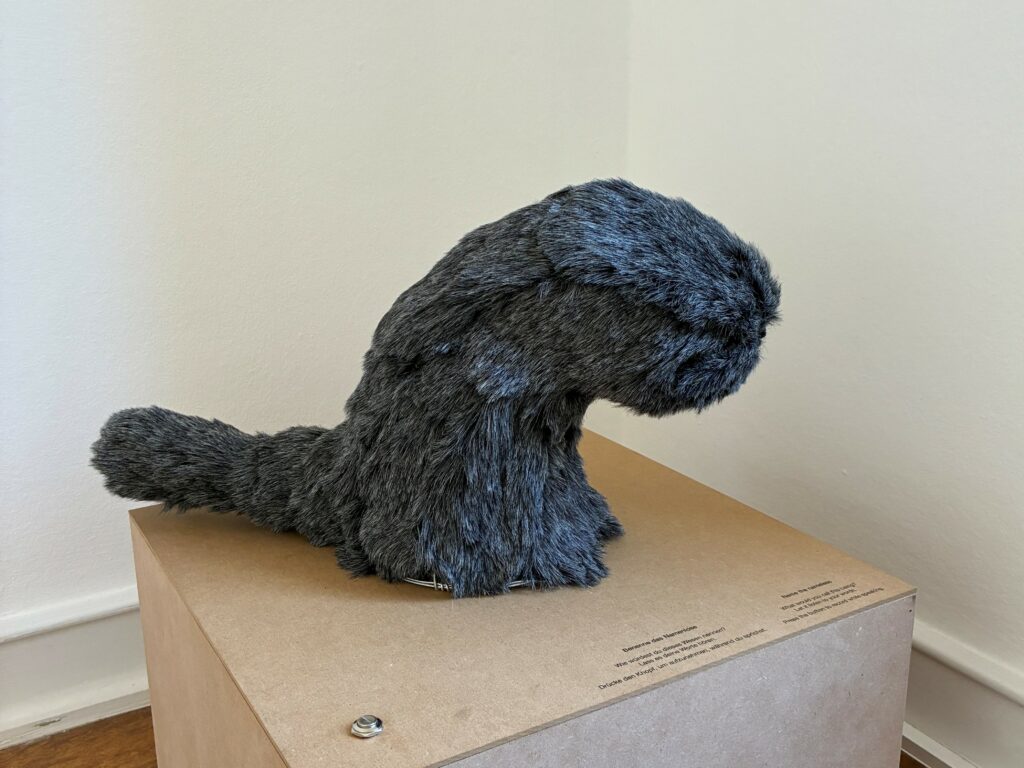
– What would you call this being? Let it listen to your words. Press the button to record while speaking.«. Foto: erinleehong
VH
Can you describe what is the difference between a natural and a synthetic sound?
HYS
In my work I tend to blur the line between what we consider natural and what is synthetic. That’s one of the points of my »Plastic Garden« series. These works are not an imitation of nature, but each is a garden in itself – a garden composed entirely of objects. I have the feeling that at some point in human history, these objects will argue that they are nature, as they have already started to take over. For the sound, I worked with recordings downloaded from BBC radio such as cowbells or parrots. They are all selected, recorded, edited by humans. Can we still say they are natural sounds? I’m quite doubtful.
IVM
I consider the synthetic as something that will eventually become part of the geological layers of earth. All these things that we keep building like instruments, but also the technologies we develop, our trash, it starts to pile up and then it becomes part of the earth’s geology. We will just be one of the layers amongst many others. We will disappear. So what is natural? What is artificial? While in the end everything is made from the earth. And when everything returns to the earth, there is no added matter. But we as humans, we need this kind of differentiation so that we can separate ourselves from machines. So we can say, this is the machine and I am the human. I’m natural and this is not natural. And maybe it’s a needed distinction to maintain our sanity.
VH
When it comes to technological progress, one sometimes gets the impression that technology is advancing faster than we can reflect on what that means for our lives. In the context of science, we sometimes talk of the limits of research. Are there also limits to your artistic research?
IVM
In my work the limits are not about the technology because I work with very old technology. But there are conceptual limits. There’s a limit to how I position the work in a political context. I always need to make sure that I address the topics with nuance.
HYS
There are also limits to our resources, such as money. Recently I have been writing applications and there are so many open calls focusing on AI or on the relationship between nature, technology and humans. They expect new ideas, but often they already seem to have their own answers. They offer open formats, but then they constrain the overall approach. I imagine that many artists, including myself, adjust our ideas or visions slightly in order to fit their criteria. This way of recruiting art is very frustrating, especially when they have big resources like funding, strong institutions, workshops or other programmes, but a very narrow and short-sighted vision.
VH
Erin and Hye, you are from South Korea, Ioana is from Romania and you’re all based in Germany now. Technological progress is taking place in these countries in very different ways and at different paces. How does your experience from your home countries differ from your experience living in Germany?
HYS
It’s very different. When I first moved to Germany ten years ago, I had to print all the documents and bring them in-person to the migration offices. This was really hard to imagine in Seoul. It’s all digital there and you can do everything on your mobile phone. These days, in Germany, you can get a Termin through an online calendar, but it’s really not enough. Also, in our daily life, there are delivery services, but compared to where I grew up, there are a lot less. In South Korea, systems that connect people beyond physical stores are very common. Online delivery and digital connectivity are familiar parts of everyday life.
ELH
But this creates a generational gap as well. It’s hard to find stores where customers can talk to humans. We have machines taking all the orders and stuff. When I was living in Germany for some years and went back just to visit, I could feel that things are growing and changing fast.
IVM
Romania was a dictatorship for a long time. After the revolution of 1989 and Romania’s integration into the European Union, it’s economy has been rising. For instance, it has the fastest internet speed in Europe. It’s like the Silicon Valley of Europe – it’s where all the hackers are because somehow everything is lacking. It developed this really big DIY culture because of scarcity, because of the time under Ceaușescu’s regime. I guess poverty is also creating this creative incentive to find ways to do what you need with what you have. It’s definitely more developed when it comes to the digital realm compared to Germany. The trains are very old but the website works.
VH
Many people are worried these days about their jobs due to AI. Are you worried as well?
IVM
For me, no. First of all, it’s not yet intelligent. It’s a language model. For now it only recycles ideas. You can input my works and ask it to make a new work, but I’m quite sure that it’s going to just turn out bullshit. So I’m not worried. I think we have actually a lot of work to do now.
HYS
And we are all growing over time. We’re constantly changing. I think AI cannot fully follow because even we ourselves have no idea how and where to grow, which direction, to what extent. No one knows. Which means AI also has no idea.
IVM
The models we have available now are being primarily developed for the military, like many of the technologies we have. They’re extremely biased as well. They’re built to think in a specific way. So I don’t see how you can come up with critical ideas from such models that are created by the people that cause our societal problems. Art needs to challenge this.
Die südkoreanische Künstlerin Erin Lee Hong lebt in Köln. Auf verschiedenen Tonträgern erforscht sie die Beziehung von Subjekten zu Geographien. Die südkoreanische Künstlerin Hye Young Sin lebt in Berlin und bewegt sich zwischen visueller Kunst, experimenteller Musik und Live Performances, in denen menschliche Intention und autonome Materialien miteinander interagieren. Ioana Vreme Moser ist eine rumänische Klangkünstlerin, die in Berlin mit Hardware-Elektronik, spekulativer Forschung und taktilem Experimentieren arbeitet.